Louvre systems are an effective way of improving a building’s energy efficiency, providing natural ventilation and airflow to building systems. To ensure best performance and protection from the weather, building designers and engineers must move away from simple specification criteria and consider a wide range of factors, says Simon Hunter, Product Manager of Louvres at Construction Specialties.
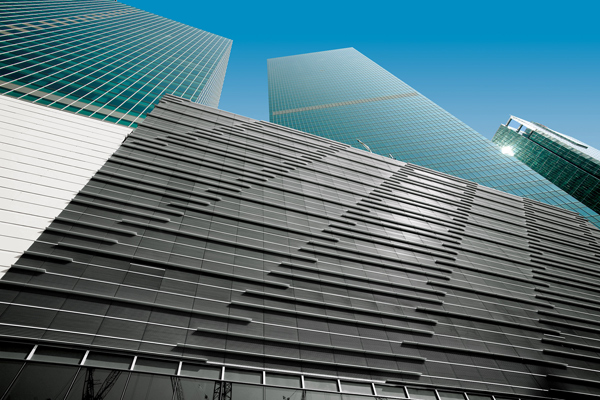
Well specified louvre system will deliver both on aesthetics and on performance
It is estimated that about 45% of the UK’s carbon dioxide emissions come from buildings: principally from space heating and cooling, water heating, lighting and other building systems. As successive UK Governments have committed to reducing greenhouse gas emissions by at least 34% by 2020 and at least 80% by 2050 (relative to 1990 levels) under the 2008 Climate Change Act, the ways in which buildings are designed and built is changing.
The emphasis these days is on ‘fabric first’ solutions and designers are increasingly using high levels of natural light and ventilation and insulation, combined with more energy-efficient building systems.
Louvre systems have an important part to play in improving buildings’ energy performance. Required on most buildings, they allow airflow, both intake and exhaust, to HVAC and other building systems, while protecting against rain ingress.
There are three main types of louvres: screening louvres, standard drainable louvres and storm-resistant (or performance) louvres.
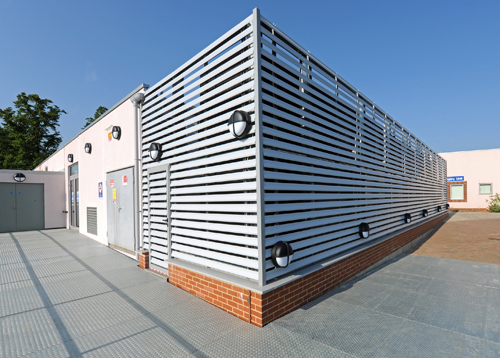
Economical and simple in their design, screening louvres are used where water penetration is not a concern
Screening louvres have the simplest blade designs and are suitable for locations where water penetration will not cause significant problems and economy is the primary consideration, such as screening of rooftop plant or in a multi-storey car park.
Standard louvres offer good airflow and some rain defence but do not perform so well with wind-driven rain. They are suitable for applications where occasional ingress of water is not a major concern and where some drainage of cascading water is required.
Storm-resistant (performance) louvres provide moderate to good airflow with excellent defence against wind-driven rain. These are typically used when high levels of ventilation and maximum protection from the rain is needed, for instance when sensitive equipment such as HVAC plant is behind the louvre.
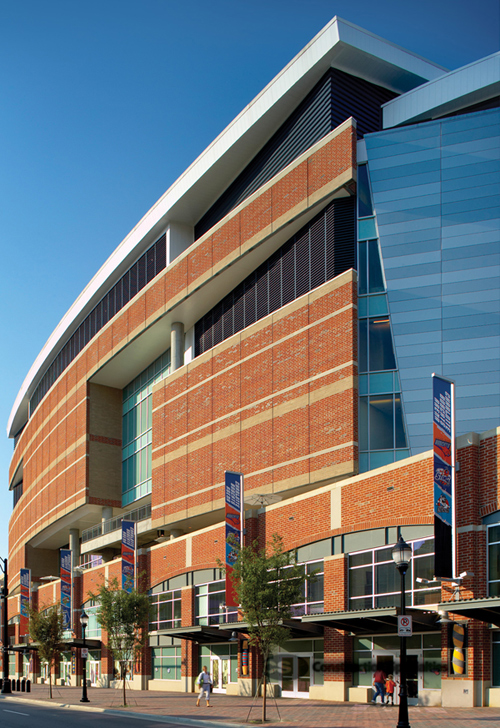
Storm resistant louvres should be used where protection against wind-driven rain is required
Specifying a louvre is always a compromise between airflow and water ingress. Traditionally, louvres are specified based on free area (typically 50%), calculated by measuring the clear distance between the blades and multiplying it by the width of the louvre panel (or height, if the blades are arranged vertically).
Clearly, free area is dictated by the size of the louvre. Industry commonly uses a 1.2m by 1.2m louvre when quoting free area but, in reality, louvres are never precisely this size. In fact, the smaller the louvre, the lower the proportion of free area. Free area can also be affected by other factors, such as additional structural support, or if bird screens or insect meshes are fitted.
Finally, free area alone does not take into account how the air flows through a louvre. All louvres restrict the passage of air and this resistance is called the pressure drop. This dictates how much air gets through the louvre and therefore how much can effectively be used. Too high a pressure drop and not enough air will be allowed through, which can cause a rapid temperature rise inside a building, in turn causing problems with plant such as generators and HVAC equipment.
As louvre design has changed in response to demand for better water protection, performance characteristics have also changed. As a result, engineers and architects should move away from specifying louvres purely on free area and instead consider a number of factors, including site location, prevailing weather conditions (in particular wind direction) and the location and exposure of the louvres (which will dictate airflow rate and the amount of potential wind-driven rain).
These should then be balanced with the required air flow, the maximum acceptable pressure drop, the degree and depth of acceptable water penetration and finally, the building’s exterior design, which can dictate where louvres can be placed and how they fit into the aesthetics.
Well specified louvre systems are an excellent way of helping building designers and engineers meet ever-more demanding environmental legislation and client requirements for sustainable buildings, playing an important role in improving energy efficiency, lowering power consumption and reducing carbon emissions.
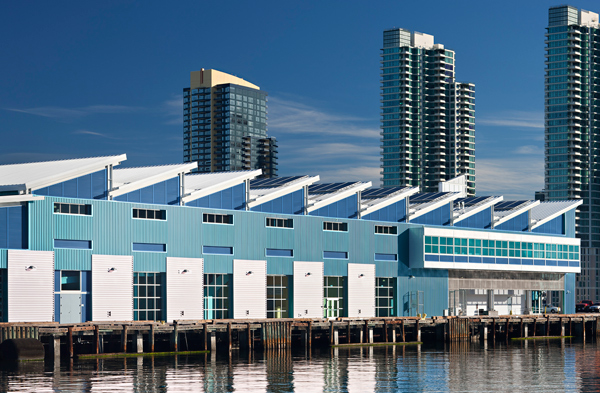
By providing natural ventilation and airflow to building systems, louvres can help to improve building’s energy efficiency
Assessing Louvre Performance
Louvre performance is tested under two main regimes: BS EN 13030: 2001 (formerly the BSRIA/HEVAC test) in the UK and Europe and AMCA 500-L-99 in the USA. The tests are technically almost identical, involving a wind and rain generator, the louvre, a collection zone and an exhaust fan. Wind-driven rain is simulated at different speeds and the louvre’s performance measured.
Performance is based upon two main factors: airflow characteristics and the effectiveness against rain penetration.
Airflow characteristics are measured by the Discharge Loss Coefficient (DLC). A DLC of 1 would be a totally open space where air can pass freely, in other words, the smaller the DLC, the greater the area of louvre required to allow the same amount of air through. There are four classes: Class 1 (a DLC of 0.4 and above) down to Class 4 (a DLC of 0.199 and below).
Effectiveness against rain penetration is assessed by subjecting the louvre to a simulated wind velocity of 13m/s and simulated rainfall at 75 litres/h/m2. Again, there are four classes, from A (0.99, or 99%, effective and above) to D (0.8, or 80%, effective and below).
Overall performance is calculated by multiplying the DLC by the penetration effectiveness. In simple terms, the higher the result, the better the performance. However, it is important to remember that this result should not be used as the sole specification criteria, as it can mask poor weather performance on a louvre with good airflow. Also, louvres that perform well at low demand rates may only give fair performance at higher rates.
Construction Specialties Performance Louvres
Construction Specialties offers a wide range of screening and performance louvres, manufactured in the UK from extruded aluminium. The range is lightweight, has high strength and is completely recyclable.
This means that Construction Specialties louvres are very effective for both ventilation and rain protection. Units are also often thinner than those relying on banks of simpler blades and additional drainage. Available with either hidden or visible mullions, these louvre systems are some of the best performing on the market.

Simon Hunter has been working for Construction Specialties (UK) Ltd for over 26 years. He started as a member of a Technical Department and progressed to become a Contracts Manager of C/S’ installation division Conspec Contracts. Two years ago Simon has been appointed as company’s Product Manager for Louvres.