The Building Centre at Ecobuild 2013

The Building Centre is pleased to be exhibiting at Ecobuild again this year. Our centre-piece is a giant, 7 x 3m Infographic which outlines (almost) everything we’ve done since Ecobuild 2012… everything from hosting 672 events, displaying 1,670 products in our galleries, adding 280 manufacturer-specific BIM components to specifinder.com and much more.
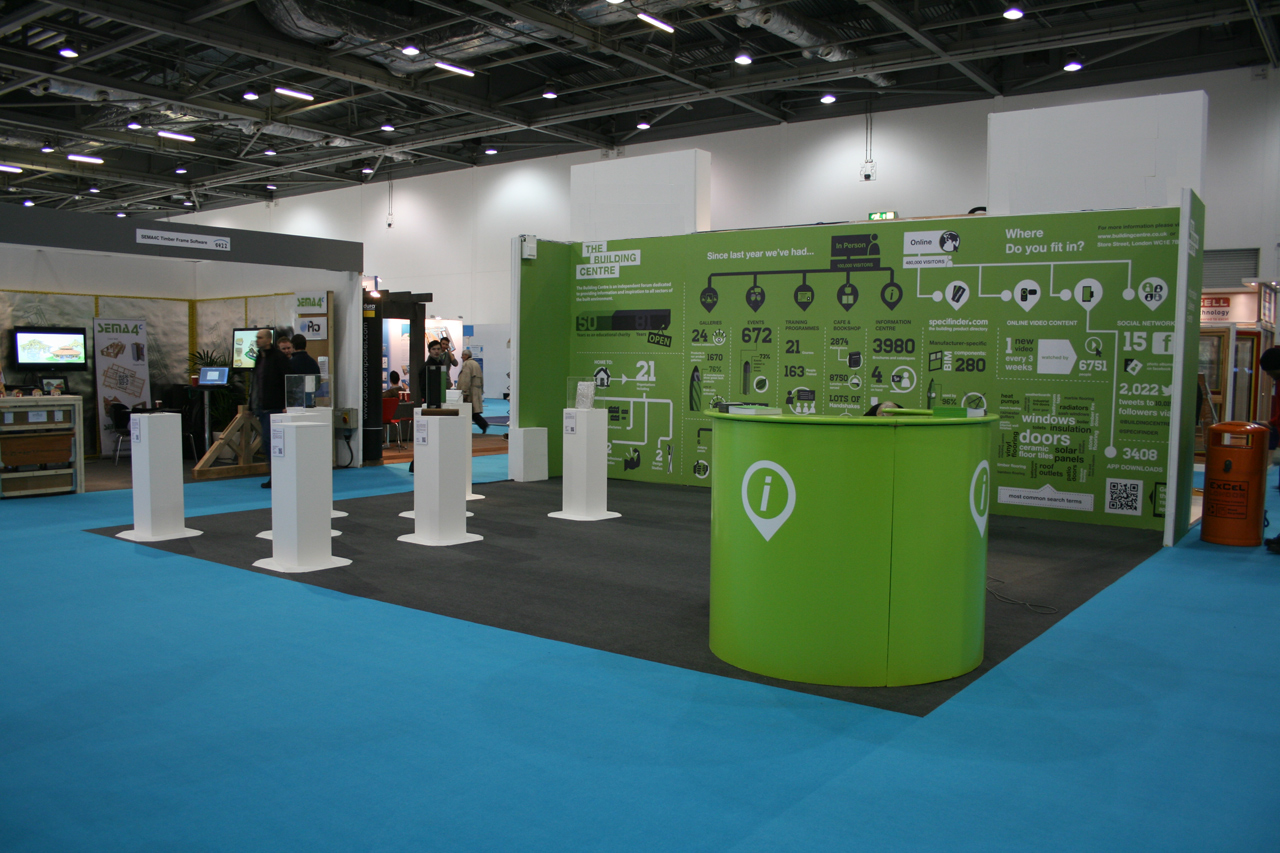
The Building Centre Stand at Ecobuild 2013, S928

The Building Centre Stand at Ecobuild 2013, S928

We’ve brought our specifinder.com team along, where we’ll be on hand to help you source building product information… and not just the products at the show, feel free to ask us whatever you’re looking for.

Our galleries are also putting in an appearance… in the form of our Mini Product Gallery. Following an open nomination process, we selected the best of the bunch and they have been presented with an impartial description on why they were chosen. Many of these products are not being displayed elsewhere at Ecobuild. The products on display are:

Nanofloor Insulation by Nanopore Insulation. New to the UK market, Nanofloor is created from Vacuum Insulation Panels (VIPs), offering a superior insulation performance, with the additional benefit of taking up to 5 times less space when compared with traditional PUR solutions.

QbissAir by Trimo UK. QbissAir has been selected for its impressive thermal performance which is achieved by controlling the thermodynamics of the system rather than using solid insulation materials.Another unique feature is the incorporation of structural members within the modules, eliminating the requirement for a secondary support structure such as a curtain wall.

FEenergysave by Daylight & Ventilation Solutions. FEenergysave is the only Passivhaus certified glass skylight for flat roofs.Independently assessed, and certified by the renowned Passivhaus Institute in Darmstadt, Germany, the FEenergysave has been awarded the top efficiency class: the Advanced Component phA category.

TeploTie Insulating Wall Ties by Ancon Building Products. The Ancon TeploTie is an insulating wall tie which is manufactured from pultruded basalt fibres set in an epoxy resin. It is an innovative composite material with an ultra-low thermal conductivity of just 0.7W/mK, making it the most thermally efficient wall tie on the market.The use of TeploTies insulates a masonry wall against heat lost through thermal bridging. This improves the thermal performance of the building and reduces energy use. Ancon are exhibiting on Stand N1110.

Kebonization by Kebony. Kebony offers a sustainable, environmentally friendly, alternative to tropical hardwood and toxic treated wood. It is easy to maintain, aesthetically pleasing, resistant to decay, non toxic, and cost effective due to good durability and long lifespan in harsh climates.The pioneering Kebonization process transforms sustainable wood species into those with comparable, and often superior, attributes to tropical hardwood. Kebony are exhibiting on Stand S925.

reAqua+ by Waterevolution. The reAqua+, by WaterEvolution is a unique and simple device that can reduce domestic water consumption by up to 30% whilst also saving up to 50% of the energy needed to heat bath and shower water.The unit collects greywater from the bath or shower, removes the heat and transfers it to the boiler then uses the cooled water to flush toilets. Waterevolution can be found on the Scottish Enterprise stand, S1010/S1110.

Hi-Therm Lintel by Keystone Lintels. This innovative patented lintel has been designed to address the next challenge in modern well insulated buildings where non-repeating thermal bridging still negatively affects thermal performance.Hi-Therm, with its hybrid Steel/GRPconstruction, has provided a highly cost effective sustainable solution to significant carbon reduction and improvements in a building’s Fabric Energy Efficiency (FEES).
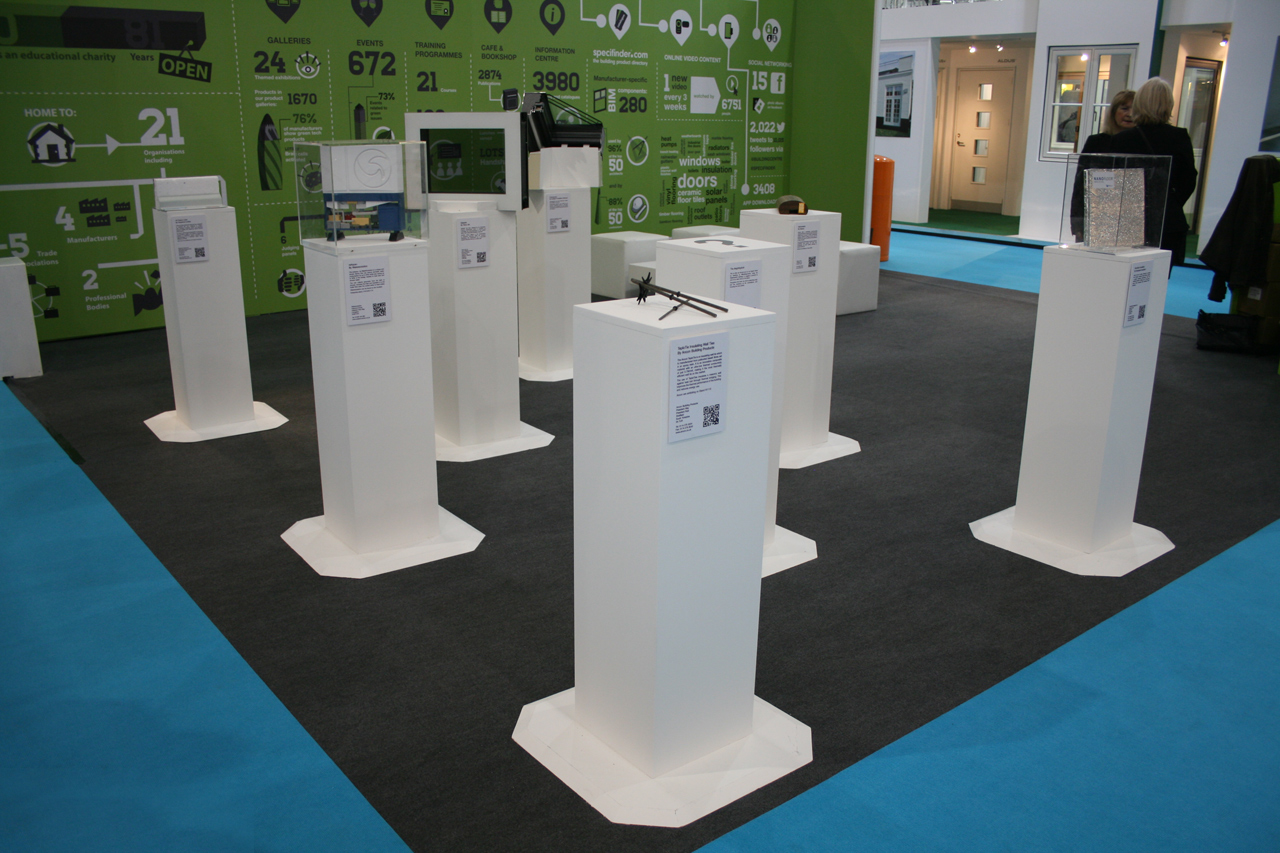
The Building Centre's Mini Product Gallery at Ecobuild 2013, Stand S928

The Building Centre's Mini Product Gallery at Ecobuild 2013, Stand S928

However, we have taken inspiration from the Fourth Plinth Project in Trafalgar Square and have allocated a space in our mini gallery for a yet-unknown item. One plinth known as ‘The Eighth Plinth’ is marked with a prominent question mark. This is reserved for a product or service that is already being exhibited at Ecobuild. Nominate your favourite product at Ecobuild (including your own if you’re a manufacturer exhibiting) and throughout the show The Building Centre staff will be searching high and low, reviewing all the nominations, and choosing the final exhibit.

You can nominate by:

1) Tweeting “Nominate [Product Name + Stand Number] for the @BuildingCentre #Ecobuild #eighthplinth”
2) Adding a comment on our specifinder page
3) Visiting stand S928 and leaving product details
4) Emailing the Product name and Stand number to [email protected] with ‘#EighthPlinth’ in the subject line.

Nominated products must be exhibited at Ecobuild. The chosen product will be included in e-shots to an audience of over 30,000 people. It will also be in The Building Centre newsletter and promoted via Ecobuild itself.

So, whatever your reason for visiting Ecobuild, please be sure to stop by our stand and say hello!

Celotex CPD Presentation on Part L: Simplifying Compliance

It was good to see that Celotex chose The Building Centre once again this year as the venue for their CPD presentation on Building Regs Part L: Simplifying Compliance.

Adrian Fryer, Specification Manager opened the proceedings and spoke of the importance of ‘Fabric First’ an expression recently coined by the government to help drive initiatives to bring down energy consumption in buildings. The latest of these  being ‘The Green Deal’ . His presentation was given excellent support by Area Sales Manager Craig Baxter.

The presentation demonstrated the use of Celotex products which it claimed would simplify compliance with Part L. With a choice of 13 different products, most design specifications can be met.

Adrian told us how Celotex is the first manufacturer of PIR insulation to achieve an A+ Green rating.

We were shown a short video about the company and its manufacturing processes. From this  we learned that Celotex  has been in existence since 1925 and  now boasts a manufacturing plant that is capable of producing one square metre of insulation board per second. Chemicals used in its PIR board production are zero ozone depleting and 60 individual checks are made on samples of each product. The film extolled the excellent properties of PIR products, proven to be more thermally efficient than mineral fibre and 10 times lighter in weight.

Craig Baxter Presents

Craig Baxter Presents

Craig Baxter mentioned the Celotex on line calculator which can be downloaded to an iPad. Members of the audience who had used it agreed that it was easy to use. Craig also talked of the technical support team of six who could be reached by phone or email.  He ran through the different Sections of Part L which apply to different types of buildings, new build, refurbishment, residential and commercial. Several interesting case studies were mentioned including Watermead Business Park, the University of Bedford, Nottingham City Council and Hepworth Gallery in Leeds. Craig said that more information on these case studies and many others could be found on their website. Emphasis was placed on U-values that could be achieved by the much thinner PIR board compared with rockfibre products.

Adrian went through the latest version of Celotex Handy Guide which seems to be very comprehensive and appears to have all the information you could possibly ever need to know about Celotex products and there applications, in a clear to understand format.

There were some interesting questions from the floor in conclusion to the morning. Someone asked ‘Why don’t you do a full fill cavity board?’ John Roper Assistant Product Development Manager was invited to the podium to give a reply. John said that they had been looking into the possibility for some time. Adrian and Craig chipped in saying that they felt  there was still concerns with condensation and a risk of moisture ingress in to the building. Adrian had mentioned earlier in the day that there was an issue with moisture in close cell structure insulation boards and that they were, therefore, not suitable for use below the DPC level because the foil would be likely to delaminate.

Someone commented that, in their experience, a building  insulated with foil faced boards blocked wireless signals and therefore could cause communication problems within the building. It was suggested that this could be overcome by creating dedicated wi-fi hotspots within the building.

John Roper (left) wth Adrian Fryer (right)

John Roper (left) wth Adrian Fryer (right)

Another delegate said they would like Celotex to produce U-values on hybrid insulation solutions: For example, where some Celotex products could be used in conjunction with another brand.  Adrian responded by saying that they couldn’t fairly comment on another company’s product’s performance, (presumably because they don’t test them). He gave the example of multi-foil insulation; out of forty four or so brands on the market only three have BBA Certification.
In conclusion Adrian said that PIR production is the fastest growing business  in the insulation market and that Celotex is working towards BREEAM Excellence and striving to lower the Lambda (the insulating capacity of a product). Part of their environment mission statement is that the amount of CO2 produced in the manufacture of PIR boards is 9 kg  lower than other PIR board manufacturers. Adrian also explained what happens to  PIR waste. It is ground to a powder and pellets are produced which can be used as a base for road building or used as fuel in brick drying kilns. PIR is recycled more in Europe and North America but there is not considered to be enough of this type of waste in the UK to warrant building a PIR waste recycling plant.

Another successful, well attended and I must say, very informative  CPD Presentation from Celotex. It’s always good to welcome Celotex at The Building Centre and we look forward to a closer relationship between us in the following months.

We hope Celotex will decide to have a bigger presence at The Building Centre soon as they are one of the few leading insulation manufacturers not to have physical representation here or an enhanced  entry on specifinder, our online directory. Although, we are pleased to say that one of their main distributors SIG plc is represented.


Energy Conversations: Green Deal or No Deal?

This was an interesting debate but does the scheme represent a real way forward or six weeks in, is it already dead in the water?

Wednesday 14th November saw the gathering of an informed cross section of experts from Government, finance and industry all interested in making the Green Deal a success.

Peter Farrand of DECC outlined the challenges of the Green Deal and the changes that have taken place since its inception. He told us of the Green Deal quick Guide on DECC’s website which is good for familiarising or re-familiarising oneself with the details.

Green Deal or No Deal? Audience

Green Deal or No Deal? Audience

Each speaker was given five minutes to put across their views and then the audience was invited to join the debate.

An Architect from the floor pointed out that there was a target to be reached of no carbon emissions from housing stock by 2050? He asked would the Green Deal help or hinder the achieving of this target if the average Green Deal was only making energy savings of 15%-20%?

Several speakers talked of ‘the whole house approach’. Peter Farrand believed it should be encouraged and whilst Steven Heath, External Affairs Director for Knauf Insulation agreed with this aspiration, he pointed out that the reality of it was that it could put a large debt on a home for many years, which was proving to be a disincentive for take-up. He gave the example of his own home and estimated that the measures to be taken towards maximum energy saving (The whole house approach) would cost between £12,000 and £15,000. This being paid off as the amount saved on energy costs and at a typical 7% rate of interest did not make a very attractive deal for home owners. He felt that loft, cavity wall insulation, draught proofing and thermostatic radiator valves were probably the most viable improvements to be offered under the Green Deal and that any other improvements would need to be financed by grants.

The unattractiveness of the Green Deal has been borne out by the lack of uptake as reported in the Press at the weekend. Six weeks since the scheme was launched – no applications have been made. The Department of Energy and Climate Change (DECC) attribute the lack of applications to people’s desire to wait until the new year before getting started on large-scale DIY projects. Umm – I wonder?

Could the truth be that it’s all about money? People are happy to become greener, to insulate and save energy if they save money. But they don’t see the reality of this scheme as saving money because to make enough improvements to make significant energy savings, the financial benefit will take a long time to realise. They will be still paying out the same amount to the energy companies in order to pay back the loan for the improvements for quite some time. Remember the bigger the improvement – the bigger the energy saving but the bigger the cost and the longer the time it will take to pay it back.

Would the Green Deal appeal to an elderly pensioner? Probably not – they may not live to enjoy the financial benefit of such improvements, although Ingrid Holmes of E3G pointed out that there are banks that will lend against the value of the property so that the loan could be repaid from their estate on their passing.

Would the Green Deal appeal to a younger couple? Probably not – they may move house before the loan is paid off. In which case they would not only not realise the benefit in their pocket but the loan would go with the house. Would this put the purchaser off? Chairman of the evening, Garry Felgate of Chop Cloc Ltd thought the Green Deal loan on the property should be viewed by mortgage providers as a variation or extension of ground rent or maintenance charges and therefore would not be a handicap to selling.

Peter Farrand, Ingrid Holmes, Paul Weaver and Steven Heath

Peter Farrand, Ingrid Holmes, Paul Weaver and Steven Heath

Ingrid Holmes of E3G took to the podium for her five minutes to talk on issues of financing the Green Deal. She examined whether the Green Deal would appear to be a logical investment for investors who would want to know what the risks would be. The scheme has no track record. Would cowboy builders install measures that failed? What happens if a consumer loses his job and therefore loses his ability to keep up repayments? These questions have resulted in a lack of backers coming forward. Ingrid said that we needed more public capitol investment to reduce interest rates.

Paul Weaver of Mansell Energy spoke from a main contractor’s point of view. He believed that large scale landlords would benefit by taking up the Green Deal.

Steven Heath of Knauf Insulation felt there should be more incentives to drive the scheme and suggested a reduction in stamp duty for buyers of a property with a green deal loan attached to it and perhaps a rise in stamp duty for the least energy efficient properties.

Although the phrase ‘The only game in town’ was bandied about a lot that evening suggesting that the Green Deal is the only way forward I didn’t get a positive vibe from the platform. There are still so many unknowns and questions left unanswered. It will be interesting to see how this one pans out.

I shall look forward to the next in the Energy Conversations series 23rd January 2013.